Programmable Drone
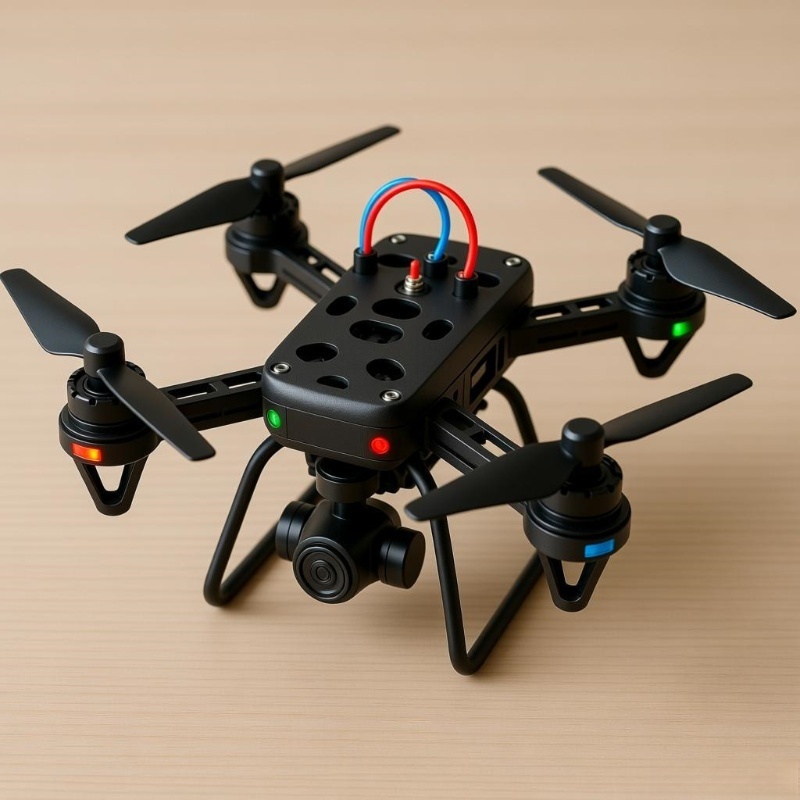
SenseDrone
- Product description:
A programmable drone is an intelligent device that integrates flight control and programming technology, designed to achieve autonomous flight, task execution, and creative displays through code. It is widely used in education, scientific research, entertainment, and industrial fields.
The SenseDrone is a formation-flying drone developed by DroneSense.AI, specifically designed for STEAM education. It supports programming in both Scratch and Python, making it ideal for teenagers to learn programming logic and spatial thinking. Its highlights include:
1. Multilingual Programming Support: Users can control the takeoff, landing, speed, rolling, and other actions of the drone through graphical Scratch modules or Python code. They can even design formation flights and light shows, synchronizing programming with full-color LED lights to achieve artistic effects.
2. Safety and Simulation System: Equipped with in-house developed simulation software, it enables users to test code logic in a virtual environment, reducing the risks of actual flight. Visual positioning technology ensures stable indoor and outdoor flight without relying on GPS or requiring additional infrastructure setup.
3. Innovative Application Scenarios: Supports multi-robot collaborative performances, suitable for events such as the "National Youth Drone Competition," enabling programmable creative graphic flight tasks. Equipped with wireless positioning technology, it achieves precise control via WiFi or repeaters.
4. Educational Ecosystem Support: Provide a teacher training system and curriculum resources to assist schools in quickly implementing drone programming education, fostering students' computational thinking and innovation capabilities.
1. Basic Parameters
• Weight: 89 grams (including battery and propellers).
• Dimensions: 97 × 92 × 41 mm (excluding expansion modules).
2. Flight Performance
• Maximum flight distance: 90 meters (WiFi connection).
• Maximum flight speed: 8 meters per second (approximately 28.8 kilometers per hour).
• Maximum flight altitude: 25 meters (can be set with App restrictions).
• Battery life: 13 minutes (in windless conditions, without expansion modules).
• Hovering Precision: Equipped with a visual positioning system (downward-facing sensor + barometer), supports precise hovering.
3. Camera function
• Camera: 4.5 megapixels, supports 5MP photos (2592×1936 resolution) and 720P/30fps video.
• Video Transmission: 720P HD real-time transmission with dual-antenna design for enhanced stability.
• Image Stabilization: Electronic Image Stabilization (EIS) technology.
• Shooting Format: Photos in JPG/PNG (depending on the app version), videos in MP4.
4. Programming and Expansion
• Supported languages: Scratch (graphical), Python, etc.
• SDK: Open DJI SDK 2.0, supporting AI development (such as object recognition and 3D reconstruction).
• Multi-Drone Control: Capable of simultaneously programming and controlling multiple drones for formation flight (up to 4 units).
• Challenge Cards: Includes 4 accompanying challenge cards for visual positioning and triggering programmed actions.
5. Battery and Charging
• Battery capacity: 1000mAh/3.8V lithium polymer battery.
• Charging method: Micro-USB interface, supports Battery Charging Manager (simultaneous charging of 3 batteries).
6. Safety and Protection
• Fail-safe protection: Automatic landing in case of low battery or signal loss.
• Protective Design: Blade guard, failsafe protection, and indoor/outdoor adaptive flight.
7. Other Characteristics
• Operating temperature: 0°C to 40°C.
• Communication Band: 2.4GHz WiFi (supports 802.11n).
• Accessory Compatibility: Compatible with expandable RoboMaster TT modules (e.g., dot matrix display, rangefinder sensor)
PREVIOUS:SenseSTEM
NEXT:SenseDetector
CONTACT US
Tel: +65 96463534
Email: info@dronesenseai.com
Add: 55 Ayer Rajah Crescent #07-05, Singapore 139949